

The use of hard drugs in America is a perpetual problem, and in recent years, it has been worsening. According to the Centers for Disease Control and Prevention, drug-related deaths in the U.S. have increased by over 500% in the last 20 years. And despite the worsening problem, on January 13th, President Donald Trump wiped out $2 billion in federal funding for drug abuse prevention. That same day, the Substance Abuse and Mental Health Services Administration (SAMHSA) sent out over 2,000 notices of budget cuts to various organizations across America that are dedicated to preventing drug abuse (Politico). It may be difficult to grasp how $2 billion affects these organizations, so allow me to make it a little more tangible. Chrissy Mayer is an employee of the DCCCA, an organization in Kansas dedicated to improving behavioral health related to drug abuse. Mayer, when prompted about the effects of the federal budget cuts, stated, “People will die from this” and “There will be consequences” (King). Essentially, this money is not just some meaningless number, it affects thousands of people’s lives and well-being. Benita Jones, a spokesperson of SAMHSA, expressed that it won’t only hurt the beneficiaries of these organizations, it may lead to the termination of the organizations themselves. When speaking about the DCCCA, she stated, “The program would not be sustainable at its current scope without this support” (King).
Less than 24 hours later, Robert F. Kennedy Jr. completely reversed the budget cuts, and all SAMHSA grants were restored to their original values. It is unclear whether the Trump administration was urged by Congress’s disapproval, or if the administration did it of their own accord. In any case, two things remain clear. First, it is horrifying that, with a few phone calls and signatures, the already deteriorating problem of drug abuse was exacerbated to this extent. While it was only for less than a day, in those few dreadful hours, millions of healthcare workers who rely on SAMHSA grants feared and prepared for the worst. Yes, they could lose their jobs, but more importantly, the work they had done for the veterans; for the children; for the LGBTQ individuals; for the families; for the people who have nothing; for honest, well-meaning American citizens; all of that would have been for nothing. Secondly, it is abundantly clear that drug abuse prevention is not a priority of the federal government, and no longer should we expect it to magically improve.
Now, before I get ahead of myself, I have to address something. It is a common notion that systemic issues in America (like drug abuse) are too complicated to understand. After all, we live in a representative democracy – why not let the representatives do their jobs? The fact is, that ship has sailed. There are three federal administrations to prevent drug abuse in America. Collectively, they have an estimated 10,769 employees and $16.5 billion average yearly funding (Indicators). Despite all of that, between 2001 and 2021, drug-related deaths have only increased (except for a small decrease between 2017 and 2018) (Spencer). In that time period, we’ve had three different presidents, two of which were Republican and one was a Democrat. Our government, on both sides, has been dormant, complacent, and they have failed us. We limit ourselves when we accept this falsehood that our problems will be fixed by someone else. It’s an engineered idea to discourage critical thinking, awareness, and scrutiny. It allows us to be content with fixable problems, it allows us to look the other way when we see inaction to fix systemic poverty, racism, sexism, poor education, global warming, etc. It even allows us to feel comfortable in the notion that there isn’t anything meaningful we can do about these issues. Now, don’t get me wrong, these issues are complicated, but change is not impossible, it simply takes time, resources, and above all, concern. Unfortunately, I am privy to all three of those things, so I alone, in my great benevolence, must take on the burden of completely reversing the drug problem in America. That was sarcastic, in case you couldn’t tell. But in all seriousness, it’s important to try. We should all use our resources to figure out what we can, to understand how these issues affect us, our friends, our neighbors, people we don’t even know, and to take steps toward enacting change.
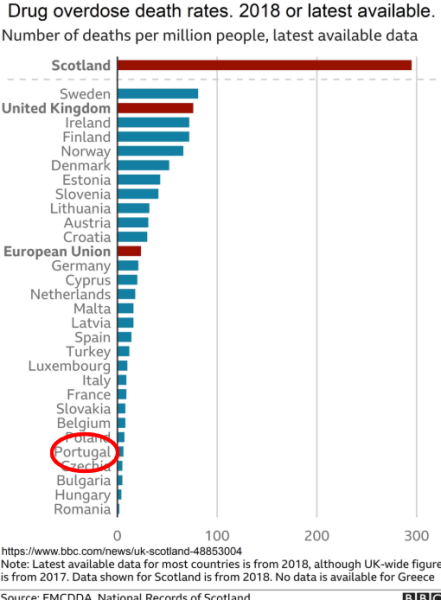
Now, establishing that as of late America has not been an exemplary model for drug abuse prevention, let’s expand our horizons and take a look at what other countries have done to fix their own drug abuse problems. In the 1990s, according to Drug Policy Alliance, Portugal had one of the highest rates of drug use and overdose deaths in Europe, an estimated total of 350 deaths per year. Bear in mind however, that number doesn’t represent the full scope of Portugal’s drug problem. Through contamination, drug abuse accounted for outbreaks of the HIV virus, leading to even more deaths. In fact, a study revealed that heroin users constituted 60% of HIV-positives during that time period. Analogous to drug abuse in America, this problem did not appear to be slowing down. However, at the turn of the century, drug use in Portugal miraculously plummeted. 350 drug-related deaths dropped to 131 in 2001, and in 2008 it dropped all the way to 20. Correlating, drug-related HIV infections dropped by 90%, and by 2018 the drug overdose death rate dropped to 3 for every 1 million, which, as you can see on the graph below, is one of the lowest rates in the EU (Drug Decriminalization).
Like the rest of the world was, you may be wondering, “What happened that brought about this phenomenal turnaround?” The answer is a strategy known as drug decriminalization. This strategy underscores the idea that punishment and fear have never been viable tactics to stop drug abuse. In fact, it can make addicts relapse and start using again. To give an example of how this can happen, the U.S. Justice System. According to the National Institute of Justice, correctional institutions (jails and prisons) in the U.S. do not only serve the purpose of holding inmates, they take upon the larger role of offering healthcare and rehabilitation. Unfortunately, this is a bald-faced lie. Correctional Institutions claim to offer viable rehabilitation, but in reality these institutions rely heavily on fear tactics and punishment (Benson). Ultimately, these tactics don’t make drug addicts stop using, and often have the exact opposite effect. In fact, over 80% of drug offenders in the U.S. will be arrested again within nine years of their initial offense. This gives it the second highest rate of re-arrest out of all possible offenses (Daniel). In effect, harshly criminalizing drug use creates a perpetual cycle of imprisonment, poverty, and relapse.
Decriminalization of drugs combats this by focusing on healing and helping the victim of drug abuse instead of punishing the “criminal.” Portugal successfully employed this strategy by treating victims with dignity and respect, as well as understanding how the victim’s socioeconomic situation may have led them down this path. When someone is seen using or possessing drugs by police, the illegal drugs are confiscated and the user is sent to a Dissuasion Commission. This commission is not to judge the penalty of the user, but instead is used to judge how they can most effectively be aided. If it is decided that the drug use is not a serious offence, no action will be taken, and if they are not found with drugs again in the next 6 months, the matter is dropped completely. If the commission decides that action is necessary, the user will often be referred to treatment, often social work or group therapy. In treatment, the user is not immediately reprimanded, scrutinized, or judged for drug use, but instead is assessed based on their family situation, economic security, social support, and education. Only after the initial assessment is the focus turned towards drug use. After treatment, programs are set up to help ex-users find a job, implement healthy habits, build a social life, and overall reintegrate themselves back into society (Drug Decriminalization). This method has worked wonders for Portugal’s drug abuse problems, and other countries, particularly in Europe, have followed suit. Norway, The Czech Republic, Netherlands, and Spain have all adopted traits of Portugal’s drug decriminalization model, and to great success.
Likewise, the U.S. gave the honest American try to drug decriminalization. Unfortunately, we failed miserably. Oregon was one of the worst cases. In 2020, due to public demand for change, Oregon decriminalized possession of drugs in small amounts. This was short lived however, by 2024 lawmakers reversed the decision and drug possession was penalized again, but by that time the damage was done; overdose deaths in Oregon had already increased by 70% (OHA). Similarly, in Seattle, San Francisco, and Washington D.C., drug decriminalization was tried and failed, spiking overdoses and drug use and ultimately leaving a bad reputation for the regions.
So what went wrong? Why does it seem the United States is unable to find a viable solution to drug abuse? The answer lies in the essential truth that the U.S., historically, is great at incarceration, and bad at healthcare. In each of these cases, decriminalizing drugs was successful in ending the vicious cycle of substance abuse and imprisonment, but that is only the first step. The downfall of each state was that they failed to address the root of the problem. In Oregon for example, the funds that were meant to be allocated towards treatment programs were delayed by 18 months, and rehabilitation programs were loosely enforced and relied on users calling a drug abuse hotline, which received 10 monthly calls despite over 7,000 referrals (Misra). Real change would have required an honest effort from lawmakers to make healthcare and drug abuse prevention programs better and readily available. What the U.S. is unable to recognize is that drug addiction is a mental health problem that must be met with compassion and mercy, not a criminal problem that can be fixed with punishment and fear. To begin to fix drug abuse, the U.S. needs to put more effort and resources into rehabilitation and mental health counseling, and less into our incarceration quotas.
Works Cited
Benson, Etienne. “Rehabilitate or Punish?” Monitor on Psychology, American Psychological Association, 2003, www.apa.org/monitor/julaug03/rehab#:~:text=Until%20the%20mid%2D1970s%2C%20rehabilitation,modest%20effect%20on%20crime%20rates.
“Drug Decriminalization in Portugal: Learning from a Health and Human-Centered Approach.” Drug Policy Alliance, 22 Mar. 2018, drugpolicy.org/wp-content/uploads/2023/08/dpa-drug-decriminalization-portugal-health-human-centered-approach_0.pdf.
“Drug Policy of Portugal.” Wikipedia, Wikimedia Foundation, 3 Feb. 2026, en.wikipedia.org/wiki/Drug_policy_of_Portugal#:~:text=Concurrently%2C%20in%20the%201970s%20and,a%20population%20of%2010%20million
“Indicators of Welfare Dependence – HHS Aspe.” U.S. Department of Health and Human Services, 2007, aspe.hhs.gov/sites/default/files/migrated_legacy_files//130436/report.pdf.
King, Suzanne. “‘It’s Constant Whiplash’: Kansas City Organizations See Mental Health Grants Canceled One Day and Restored the Next .” Beacon, 16 Jan. 2026, thebeaconnews.org/stories/2026/01/16/mental-health-grants-canceled-one-day-and-restored-the-next/#:~:text=%E2%80%9CWe%20are%20evaluating%20which%20services,programs%2C%20including%20suicide%20prevention%20work.
Mann, Brian. “Trump Administration Sends Letter Wiping out Addiction, Mental Health Grants.” NPR, NPR, 14 Jan. 2026, www.npr.org/2026/01/14/nx-s1-5677104/trump-administration-letter-terminating-addiction-mental-health-grants.
Misra, Riya. “Oregon’s 2020 Drug Policy Didn’t Treat ‘Root Causes’ of Use, Attorney General Says – Politico.” Politico, 11 Oct. 2025, www.politico.com/news/2025/10/11/oregon-drugs-measure-110-00602289.
“OHA Sees 70% Increase in Oregon Drug Overdose Deaths during April, May.” Oregon Health Authority : OHA Sees 70% Increase in Oregon Drug Overdose Deaths during April, May : External Relations Division : State of Oregon, 28 Oct. 2020, www.oregon.gov/oha/erd/pages/oha-sees-70-percent-increase-in-oregon-opioid-deaths-during-april-may.aspx.
“Politico Pro: HHS Terminates, Then Reinstates, Thousands of Grants for Substance Use, Mental Health.” Subscriber.Politicopro.Com, subscriber.politicopro.com/article/2026/01/hhs-terminates-grants-substance-use-mental-health-00729433. Accessed 20 Feb. 2026.
Spencer, Merianne Rose. “Products – Data Briefs – Number 457 – December 2022.” Centers for Disease Control and Prevention, Centers for Disease Control and Prevention, 21 Dec. 2022, www.cdc.gov/nchs/products/databriefs/db457.htm.
“What Types of Crimes Are Likely to Result in a Re-Offense? | Terri Daniel, Attorney at Law, PLLC.” Terri Daniel Law, www.terridaniellaw.com/blog/2023/11/what-types-of-crimes-are-likely-to-result-in-a-re-offense/. Accessed 20 Feb. 2026.