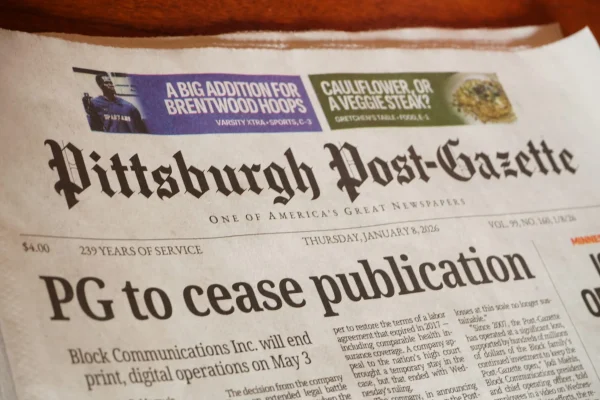
Despite the Pittsburgh Post-Gazette’s scheduled closure for May 3, 2026, the paper continues to publish due to a last-minute ownership change. In April, they were purchased by the Venetoulis Institute for Local Journalism, a Baltimore-based nonprofit. As their name suggests, the company is dedicated to preserving and supporting local journalism.
The new leadership took control of the Gazette from the previous owners, the Ohio-based Block Communications Incorporated, on May 4, 2026. In concordance with their aspirations of preserving local journalism, the Venetoulis Institute leaders are minimizing the changes that they will make. The name of the paper will remain the same, as will the print publication days (Thursdays and Sundays). Additionally, the newsroom and local business leadership will remain in Pittsburgh. They have also announced that readers can continue to expect fair and accurate reporting from the Gazette.
Still, some operational changes are expected under the new leadership. The technology and business operations, for example, will be combined with Venetoulis’s existing teams.
The previous owners, Block Communications Incorporated, owned and operated the Pittsburgh Post-Gazette from 1927 until May of this year. The sale came just one year before Block Communications would have reached a century of ownership. However, the paper existed long before Block’s acquisition. Post-Gazette representatives cite it as existing in Pittsburgh since 1786, making it one of the oldest newspapers in the country. Additionally, it is Pennsylvania’s second-largest newspaper.
The projected closure, announced in January of 2026, was a result of ongoing financial losses. In a public statement, Block Communications said that it had lost more than $350 million operating the newspaper over the past two decades, and could no longer sustain those losses.
The continuation of the Post-Gazette is significant not only for Pittsburgh readers, but also for the broader future of local journalism. As local newspapers across the country face financial instabilities and closures, the preservation of one of Pennsylvania’s oldest and largest newspapers provides a rare moment of optimism in the local journalism scene.